Here are images of my custom stained glass works installed in homes and offices around the country. Contact me if you are interested in a custom piece. Here are some frequently asked question about how the process of commissioning a custom piece works:
How are your panels installed?
My work can be installed in two ways. A free hanging panel can be hung with wire from eye hooks that are screwed into a window frame. This allows a double hung window to move up and down behind the stained glass. This works with a casement window too. Another option is to build in a custom piece to a fixed window unit.
How much would a window cost?
My work generally starts at around $800 per square foot.
Where do we begin?
I ask clients to look through my portfolio to get a sense of which of my panels they connect with and we go from there.
Can you ship a panel across the country?
Yes!
Can one of your windows be any size?
Yes, but if its really big I might have to make it in sections. Bigger than 3 ft x 3 ft gets a little unruly but it can be done!
Would you make me window in the style of Tiffany?
No, I work in my own style.
Is all the work done by you?
Yes, I hand craft every piece.


This piece is a biggie, measuring 33” wide by 50” tall! I sandblasted flashed glass and added high fire enamels to create the colorful circles. Because the client wanted privacy from the neighbors I used a prismatic glass called reedy for the background. The construction is lead and the frame is poplar painted black.

To create this patchwork I sandblasted patterns I designed into flashed glass. I constructed the piece using lead came and installed it into a wood frame.

Here’s a great shot. The window shoots lots of color into the home at different times of the day and year. The client has sent me lots of amazing pictures. Thanks, Ger!


Here’s an example of how to hang one of my panels. You can hang them using wire and eye hooks in front of a double hung window so the window can still be opened.
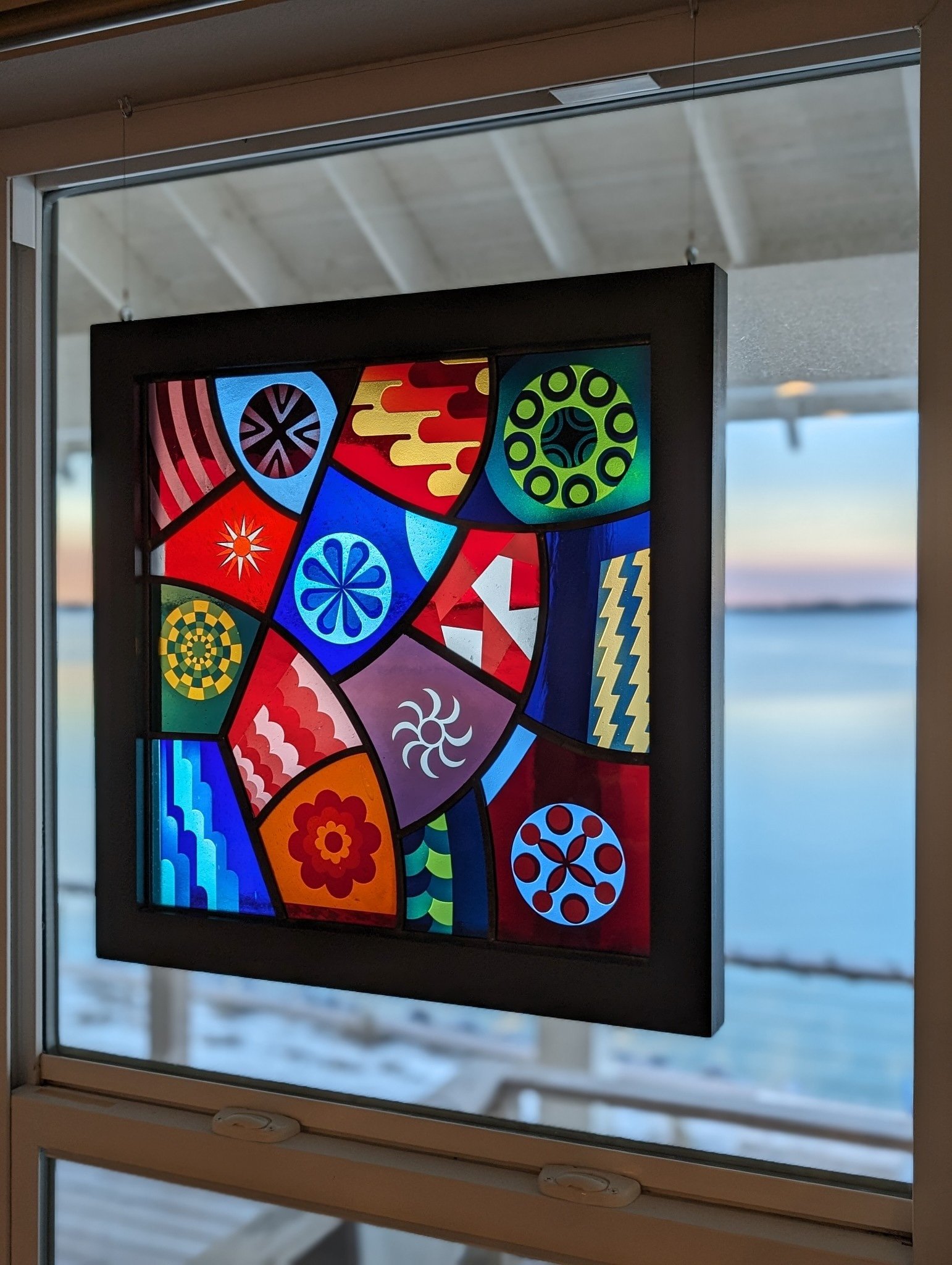
Its a perfect spot for this piece. It helps to partially block the sight of the porch overhang while not obstructing the incredible ocean views.

This was my first circle! This was a panel for an avid quilter. It was fun to incorporate my fabric inspired patterns into a window for her. I sandblasted the glass and used high fire glass paints and enamels.

This is an internal door. The circles in this panel are two layers of sandblasted glass plated on top of each other.

Here is a detail shot of one of the oceanography windows. I love how the dappled light coming through the handblown glass creates such an underwater look!

Here is an in situ shot of the oceanography windows in their ‘valance’ position at the top of a pair of double hung windows .

I love these door panels! It was fun to keep a grid pattern and then checker board fun designs through it. I sandblasted the glass and added high fire glass paints and enamels.

This is one of my all time favorites! This picture shows how easy it is to hang one of my panels using wire. Its strung through eye hooks at the top of the window frame, forward enough that the bottom sash can still come up behind it. Each circle was created by sandblasting and painting two pieces of glass and plating them on top of each other. I love the depth of pattern and color that creates, like a kaleidoscope.

This is one of a matching pair of windows inspired by the artwork of 19th century botanist Ernst Haeckel. I love the way he translated natural forms in a beautiful stylized way. I sandblasted the glass and added high fire glass paints and enamels to add more details.

I first made the two bottom panels to create privacy. They were inspired by the artwork of the 19th century botanist Ernst Haeckel. When the neighbor added an addition we created two more windows. I sandblasted the glass and added high fire glass paints and enamels to create these images.

This an internal window between an office and the double height living room. The influence of kimono patterns on my work is evident in this fan pattern. I sandblasted the glass and added high fire glass paints and enamels to create these patterns. They are constructed using lead.